Squash ball colours explained: a parent’s guide
The coloured dots on a squash ball tell you how bouncy it is. Children learning the game usually rally best with the bouncier balls, the blue or red dot, while the double yellow dot is the competition standard used by experienced players. Here is what each colour means, and how to pick the right ball for your child.
In short:
- The dots show speed and bounce: blue is the bounciest, then red, single yellow and double yellow.
- England Squash describes the blue ball as perfect for beginners and juniors.
- Only the two yellow-dot balls have official specifications: 40.0 mm across and 24 g in weight.
- Squash balls bounce more as they warm up, so a cold court often calls for a bouncier ball.
- If you are unsure, ask your child’s coach which ball the sessions use.
What the dots mean
The World Squash Federation’s ball specification gives each ball a speed label. The double yellow dot is “super slow” and the single yellow dot is “slow”. A red dot is “medium” and a blue dot is “fast”, and both can be made larger than the standard 40 mm, which makes them easier to see and hit. You may also come across a green dot, which is the specification for a high-altitude ball.
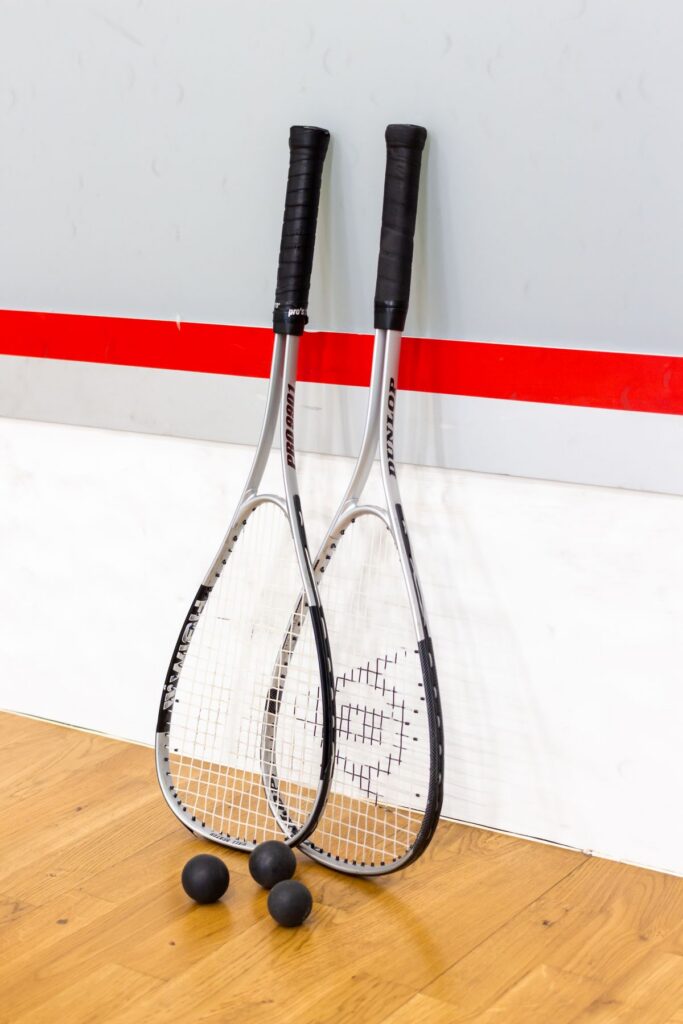
Only the two yellow-dot balls have full official specifications. Both must be 40.0 mm in diameter (give or take half a millimetre) and weigh 24 g (give or take a gram). The difference between them is how much they bounce: the single yellow “club” ball must rebound higher than the double yellow “competition” ball in the standard drop test.
Why bouncier balls suit children
A bouncier ball stays in the air longer, which gives a child more time to reach it and play a shot. That means longer rallies and more time actually playing, rather than picking the ball up. England Squash’s equipment guidance explains that larger, bouncier balls allow more time to get a rally going and help players develop the correct technique. It describes the blue ball as having the highest bounce and being perfect for beginners and juniors, and the red ball as the next step for improving or recreational players.
For the youngest children there is also the Uni ball, which England Squash lists as a larger ball with a slower, forgiving bounce, designed as a gateway into the game for beginners of any age.
When children move on to yellow balls
The single yellow dot suits regular club players and is a middle ground between the beginner balls and the competition ball. The double yellow dot is the standard for competitive squash: under the Rules of Squash it is the ball used at World Championships, and it performs best once it has warmed up through fast, continuous rallies.
There is no fixed age for moving up. England Squash’s advice is simply to choose the ball that keeps rallies going, so follow the coach’s lead on when your child is ready to try a less bouncy ball. Our squash kit guide for children covers what else they need, and it is worth knowing that England Squash requires eye protection for all under-19 players in competition.
Court temperature matters
Squash balls bounce more as they warm up through play. A guide on Play Squash, England Squash’s participation platform, points out that on a cold court even yellow balls can feel flat, and suggests switching to a red dot, blue dot or Uni ball when rallies keep breaking down. The right ball can change with the season, so it is worth having a bouncier spare in the bag.
Common questions
Which ball should my child start with? England Squash points beginners and juniors to the blue dot ball, with the Uni ball as another forgiving option for new players of any age.
Which ball do competitions use? The double yellow dot is the competition standard under the Rules of Squash. Junior sessions and events may use bouncier balls, so check with the club or the event organiser.
What does a green dot mean? It is the World Squash specification for a high-altitude ball, designed to bounce less in thinner air. You are unlikely to need one in the UK.
Where can I read more? See our guides to a first squash session and squash rules and scoring, or browse all our squash guides for parents.